
Every winter, snow accumulates on the roofs of homes and commercial buildings in Quebec. After several storms, a common question arises: should you have the snow removed from your roof or wait for it to melt naturally?
There is no single amount of snow that means every roof must be cleared. Snow weight, rain and thaws, and the condition of the building are all factors to consider. Here are the signs to watch for to determine when action may be needed.
How Many Centimetres of Snow Mean a Roof Needs to Be Cleared?
Contrary to a common belief, there is no universal rule that a roof must be cleared as soon as snow reaches a depth of 30 cm.
Roofs are designed to support certain snow loads under applicable construction requirements. However, structural capacity varies with the building type, age, design and condition.
A depth of 30 cm of light snow does not weigh the same as 30 cm of wet or compacted snow.
The visible amount of snow is therefore not enough to determine whether a roof needs to be cleared. Weather conditions and signs of overloading must also be considered.
When Should Snow Buildup on Your Roof Be Assessed?
Your roof does not need to be cleared after every storm. However, some winter conditions call for particular vigilance, especially when several snowfalls occur in succession or a thaw brings rain onto already substantial snow buildup.
According to the Régie du bâtiment du Québec (RBQ), snow weight and signs of overloading are important factors to monitor, regardless of snow depth.
| Observed situation | Possible risk | Recommended action |
|---|---|---|
| Light snow after a storm | A generally lighter load than the same depth of wet snow | Monitor buildup and weather conditions |
| Several storms close together | A gradual increase in the load on the roof | Have the situation assessed if buildup becomes substantial |
| Rain or freezing rain on a snow-covered roof | Increased weight of snow and ice | Consult a specialist if substantial buildup is already present |
| Wet or heavily compacted snow | A potentially heavy load, even without very deep snow | Have the roof assessed when conditions become concerning |
| An ice dam along the roof edge | Trapped water that may seep beneath the roof covering | Have watertightness checked and determine whether ice removal is needed |
| Unusual cracking sounds, new cracks or a distorted ceiling | Possible signs of overloading or structural deformation | Stay out of the hazardous area and request an urgent assessment |
Key point: a roof may need attention even when snow buildup appears moderate. Conversely, substantial buildup does not automatically mean the structure is overloaded.
If you notice signs of deformation or fear a collapse, evacuate the premises and contact emergency services if there is immediate danger. Do not climb onto the roof to try to solve the problem yourself.
What Are the Signs of Snow Overloading on a Roof?
The Régie du bâtiment du Québec (RBQ) recommends watching for changes that may indicate unusual stress on a building’s structure.
Signs to take seriously include:
- Unusual cracking sounds coming from the structure.
- New cracks appearing in interior walls.
- Doors that suddenly start sticking or rubbing.
- A ceiling that appears distorted or sagging.
These signs are not necessarily caused by snow weight. However, when they appear during a period of heavy snow buildup, it is important not to ignore them.
If you notice signs of overloading, stay out of the potentially hazardous area and have the situation assessed promptly. If there is immediate danger, evacuate the premises and contact emergency services.
Why Does Wet Snow Pose a Greater Risk?
Not all snow buildup places the same load on a roof.
Fresh snow generally contains a great deal of air. Over time, it settles and becomes denser. When it absorbs water during a thaw or rainfall, its weight can increase considerably.
In Quebec, winter temperature fluctuations make this situation particularly important to monitor.
The Effects of Freezing and Thawing
When some snow melts and then refreezes, a layer of ice may form. Subsequent precipitation adds to the existing buildup.
These conditions can increase the load on the roof, create compacted snow buildup and cause ice to form in certain areas.
Rain falling on snow deserves particular attention, especially when buildup is already substantial.
Does a Flat Roof Need Snow Removal More Often Than a Sloped Roof?
Roof type affects how snow accumulates, but it does not determine how often snow needs to be removed on its own.
Snow Removal from a Flat Roof
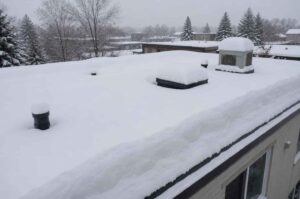
On a flat roof, snow can remain in place for much of the winter. Wind can also create uneven buildup near parapets, equipment and changes in roof height.
Roof drains require particular attention. When snow or ice blocks drainage, meltwater can accumulate on the roof.
Snow removal from a flat roof in winter must also take the membrane type into account, including elastomeric and TPO membranes, to limit the risk of damage.
Snow Removal from a Sloped Roof
On a sloped roof covered with asphalt shingles, some snow may slide off naturally. However, this does not always happen.
Snow can remain in valleys, near dormers or where different roof slopes meet.
Even a steeply sloped roof may therefore require particular attention, depending on winter conditions.
| Roof type | Winter characteristics | Points to monitor |
|---|---|---|
| Flat roof | Snow that remains in place, uneven buildup | Drains, parapets and membrane condition |
| Sloped roof | Snow may slide off | Valleys, dormers and roof edges |
| Roof with multiple slopes | Localized buildup may occur | Junctions and changes in height |
| Roof with equipment | Snow may accumulate around obstacles | Vents, equipment and hard-to-reach areas |
Ice Dams: Does the Roof Always Need to Be Cleared?
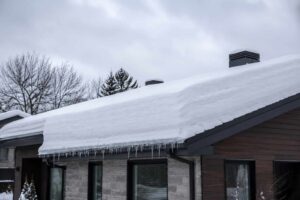
Ice dams generally form when snow melts on part of the roof, then refreezes near the colder roof edge.
Ice can prevent meltwater from draining normally. In some circumstances, this water can seep beneath shingles and damage the interior of the building.
An ice dam does not necessarily mean the entire roof needs to be cleared. Targeted ice removal or another intervention may be more appropriate.
When this problem returns every winter, it is also worth checking attic insulation and ventilation, as well as the roof’s watertightness.
Ice removal can resolve an immediate situation without necessarily eliminating the cause of the problem.
Can You Remove Snow from Your Roof Yourself?
Roof snow removal involves several risks, particularly when ice is present or the roof has a steep slope.
A fall, a sudden slide of snow or contact with electrical wires can cause serious injuries.
Using unsuitable tools can also damage the roof covering. A metal shovel can damage asphalt shingles or puncture a waterproofing membrane.
The RBQ recommends entrusting roof snow and ice removal to specialized companies with the necessary equipment and knowledge.
Climbing onto a snowy roof to check the snow depth yourself or remove substantial buildup is not recommended.
When Should You Call a Professional for Roof Snow Removal?
Your roof does not automatically need to be cleared after every storm. Regular monitoring can, however, help identify situations that warrant an assessment.
It may be appropriate to consult a professional when several storms occur in succession, snow becomes particularly heavy after a thaw, or substantial buildup forms in certain areas.
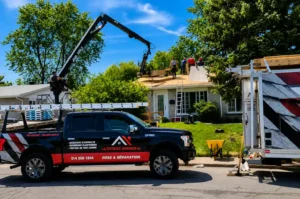
On Montreal’s South Shore, Les Toitures E. Bourgeois offers roof snow removal on the South Shore for residential and commercial properties.
The appropriate intervention depends on the roof type, its covering and the conditions observed.
How Can You Prevent Roof Problems During Winter?
Prevention starts before the first heavy snow buildup.
A roof in good condition, adequate attic ventilation and functional drainage systems help limit some winter problems.
In autumn, it is useful to check the condition of shingles, flashing and other components exposed to the weather.
An inspection and roof maintenance can identify watertightness problems or deteriorated materials before winter arrives.
During the cold season, monitor snow buildup from a safe location and pay attention to unusual changes inside the building.
Frequently Asked Questions About Roof Snow Removal
Must You Remove Snow from Your Roof Every Winter?
No. Routine snow removal is not necessary for every roof. Instead, monitor snow buildup, weather conditions and signs that may indicate overloading.
Is 30 cm of Snow on a Roof Dangerous?
Not necessarily. A depth of 30 cm alone does not determine whether a roof is overloaded. Snow weight and the building’s characteristics must also be considered.
Can You Wait Until Spring for the Snow to Melt?
When the roof shows no concerning signs, natural melting may be sufficient. However, do not wait if signs of overloading, significant water infiltration or a danger from falling ice are observed.
Does an Ice Dam Mean the Roof Needs Snow Removal?
No, not automatically. Depending on the situation, localized ice removal may be sufficient. If the problem recurs, possible causes must also be investigated, particularly attic insulation and ventilation.
Who Should You Contact for Roof Snow Removal on the South Shore?
A contractor specializing in roof snow removal can assess conditions and determine the appropriate intervention. Les Toitures E. Bourgeois offers this service on Montreal’s South Shore, including Brossard, Longueuil, Boucherville, Saint-Bruno-de-Montarville and Sainte-Julie.
After the snow melts, see our spring roof maintenance tips to prepare for seasonal inspections.
Summary
The decision to remove snow from a roof in Quebec is not based solely on the number of centimetres that have accumulated.
Snow weight, thaws, roof type and signs of overloading are the main factors to monitor.
When in doubt, a professional assessment can determine whether snow removal is needed, without taking unnecessary risks.
Technical source: Régie du bâtiment du Québec — Roof Snow and Ice Removal: A Matter of Safety!, February 26, 2025.